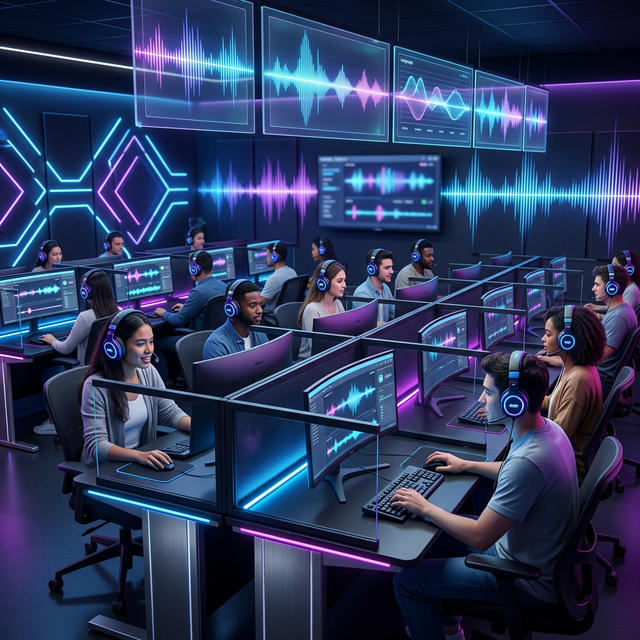
In the digital age, the ability to communicate effectively in English and other global languages is no longer just a "skill"—it is the baseline for career success. For academic institutions, especially degree colleges and professional institutes, bridging the gap between curriculum and corporate expectations is a constant challenge. This is where digital language lab software emerges as a transformative solution.
The Global Shift: Why Language Mastery Matters More Than Ever
We live in a hyper-connected world where a developer in Pune might be collaborating with a client in New York, or a sales executive in Mumbai might be pitching to a firm in London. In this ecosystem, technical proficiency often takes a backseat if the candidate cannot articulate their thoughts clearly. Statistics consistently show that over 80% of corporate recruiters prioritize "Soft Skills" and "Linguistic Accuracy" during high-stakes placement rounds.
However, traditional classroom settings often fail to address individual pronunciation issues, phonetic errors, or communication anxiety. A lecturer speaking to a class of 60 students cannot provide the personalized feedback required for language acquisition. This pedagogical gap is what modern digital language lab software is designed to fill.
What Exactly is Digital Language Lab Software?
A digital language lab is an advanced multimedia platform that converts a standard computer lab into an immersive linguistic training center. Unlike the old-school "cassette-based" labs of the 1990s, modern systems utilize high-definition audio-visual tools, AI-driven speech analysis, and real-time teacher-student interaction modules.
It creates a safe, private, and interactive environment where students can listen to native speakers, record their own voices, compare waveforms, and rectify their pronunciation without the fear of being ridiculed by peers. It is a transition from "Passive Learning" to "Active Practical Application."
Key Features of Modern Language Lab Systems
To truly understand how this technology helps colleges, one must look at the core features that differentiate a premium system from a simple media player:
- Waveform Comparison: Students can see the visual representation of their voice compared to a native speaker's waveform. This helps them understand stress, intonation, and rhythm—the "music" of the language.
- Teacher Console Control: The instructor has a master dashboard to monitor any student's screen, listen to their practice discreetly, and provide private feedback through the intercom.
- Phonetics and Mother Tongue Influence (MTI) Removal: Specialized modules focused on neutral accent training help students overcome regional accents that might hinder global intelligibility.
- Role-Playing & Group Discussion Simulation: The software allows the teacher to pair students digitally for real-time dialogues, simulating corporate meetings or interview scenarios.
- Comprehensive Content Library: Ranging from basic grammar and vocabulary to advanced business communication and TOEFL/IELTS preparation materials.
Specific Benefits for Colleges and Professional Institutes
Implementing digital language lab software isn't just an IT upgrade; it is a strategic academic advancement for the following reasons:
1. Boosting Campus Placement Success Rates
Colleges are ultimately judged by their placement records. A student who might be a topper in Mathematics but stumbles during a Group Discussion is a loss for the college's reputation. Language labs drastically improve the "employability quotient" of students by polishing their verbal and non-verbal communication skills.
2. Empowering Students from Rural Backgrounds
In many Indian colleges, students from rural areas are exceptionally brilliant in core subjects but suffer from "English Phobia." The private nature of the digital lab allows them to practice at their own pace, starting from basic level modules and gradually moving to advanced public speaking, without public embarrassment.
3. Standardizing Language Training
In a traditional classroom, the quality of language training depends heavily on the individual teacher's accent and fluency. Digital language lab software provides a standardized "Reference Model" of native-like audio, ensuring every student gets the same high-quality linguistic exposure regardless of the instructor.
4. Detailed Progress Tracking
Modern systems generate automated reports for every student. Teachers can track how many hours a student spent on phonetics, how much their pronunciation score improved, and where they are still struggling. This data-driven approach allows for targeted remedial teaching.
How Colleges Can Maximize the ROI of a Language Lab
Merely installing the software is not enough. For a college to truly see results, they must integrate the lab into their weekly timetable. Dedicated "Communication Lab" sessions should be mandatory for all streams—Science, Commerce, and Arts. Encouraging peer-to-peer interaction through the software's "Dialect Bridge" features can turn a dull lab session into a vibrant hub of learning.
Furthermore, using the lab for mock interview recordings allows students to play back their own performance, helping them realize their body language flaws and verbal fillers (like "um," "ah," or "you know"), which are often the hidden culprits behind interview failures.
The Future: AI and Beyond
As we look toward 2026 and 2027, digital language lab software is incorporating Artificial Intelligence to provide real-time facial expression analysis during speech and automated grading systems that rival human examiners. Institutions that adopt these technologies now will be at the forefront of the educational revolution.
Conclusion: Empowering the Next Generation
The role of a college is to prepare a student for life, not just for an exam. In a world where communication is the currency of success, a digital language lab is the most valuable investment an institution can make. It transforms hesitant speakers into confident leaders, and local graduates into global professionals.
Ready to transform your college's communication standards?
At Swarupa Services, we specialize in deploying state-of-the-art digital language lab software tailored for Indian academic environments. From site survey and installation to comprehensive teacher training, we handle everything.
Book a Free Live Demo today and see the difference our software can make in your institution!